Bisherige Auswahl:
keine Auswahl
Ergebnis einschränken:
|
 |
| Bemerkungen / Titelliste: |
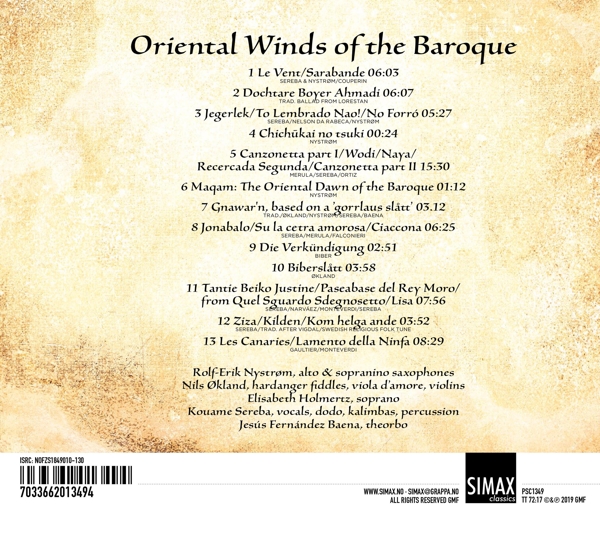
 01. "Sereba/Nystrom: Le vent - Couperin: Konzert Nr. 14: Sarabande" 02. "Dochtare boyer ahmadi" 03. "Sereba: Jegerlek - Da Rabeca: To lembrado nao! - Nystrom/Sereba - No forr¢" 04. "Chichukai no tsuki" 05. "Merula: Canzonetta sprituale über Alla Nanna - Sereba: Wodi - Naya - Ortiz: Recercada Nr. 2 - Merula: Canzonetta..." 06. "Maqam: The oriental dawn of the baroque" 07. "Gnawar'n (nach Gorrlaus Sl?tt von Vidar Lande)" 08. "Sereba: Jonabalo - Merula: Su la cetra amorosa - Falconieri: Chaconne" 09. "Rosenkranz-Sonate Nr. 1 (Die Verkündigung Mariae)" 10. "Bibersl?tt" 11. "Sereba: Tantie Beiko Justine - De Narváez: Paseabase del rey moro - Monteverdi: Quel sguardo sdegnosetto - Sereba: Lisa" 12. "Sereba: Ziza - Vigdal: Kilden - Kom helge ande" 13. "Gaultier: Les Canaries - Monteverdi: Amor, dicea... Lamento della ninfa" 01. "Sereba/Nystrom: Le vent - Couperin: Konzert Nr. 14: Sarabande" 02. "Dochtare boyer ahmadi" 03. "Sereba: Jegerlek - Da Rabeca: To lembrado nao! - Nystrom/Sereba - No forr¢" 04. "Chichukai no tsuki" 05. "Merula: Canzonetta sprituale über Alla Nanna - Sereba: Wodi - Naya - Ortiz: Recercada Nr. 2 - Merula: Canzonetta..." 06. "Maqam: The oriental dawn of the baroque" 07. "Gnawar'n (nach Gorrlaus Sl?tt von Vidar Lande)" 08. "Sereba: Jonabalo - Merula: Su la cetra amorosa - Falconieri: Chaconne" 09. "Rosenkranz-Sonate Nr. 1 (Die Verkündigung Mariae)" 10. "Bibersl?tt" 11. "Sereba: Tantie Beiko Justine - De Narváez: Paseabase del rey moro - Monteverdi: Quel sguardo sdegnosetto - Sereba: Lisa" 12. "Sereba: Ziza - Vigdal: Kilden - Kom helge ande" 13. "Gaultier: Les Canaries - Monteverdi: Amor, dicea... Lamento della ninfa"
|
| | Anzahl der Tonträger: |
1 |
| | Beschreibung: | Saxophonist par excellence Rolf-Erik Nystrøm is at the helm of Oriental Winds of the Baroque - exploring Baroque music through it's connections with the Orient, Africa, South-America and the Nordic regions. Biber, Merula and Monteverdi's passacaglias are as much a common denominator for interaction between different cultures as the blues. The European art music in the baroque era did not suddenly appear in a magic fountain in the centre of Europe around 1600. Quite the opposite; it developed through immigration, conquest, assimilation, curiosity and openness. Oriental Winds of the Baroque follow these lines backwards, open to what might turn up. Biber's re-tuning the strings and using improvisation in his music, is closely connected to how the folk musicians all over Europe worked, especially in Norway. Furthermore the tonality of the traditional religious songs in Norway, is sometimes similar to the way religious and other music is sung in the Middle East. Kouame Sereba's timeless vocals, dodo and kalimba can together with the Italian theorbo and the Norwegian traditional Hardanger fiddle give the listener associations to the curious intercultural meetings that became the origins to the later stylized baroque and classical music, and then in turn our other Western musical styles. The calm and breath in the music of Couperin is found in the aesthetics of the breath and space in the individual expressions of Sereba, Økland and Nystrøm., Runningtime: 00:00:00, Alto Saxophone, Sopranino Saxophone: Rolf Erik Nystrøm, Calligraphy [Calligraphy Cover], Cover [Calligraphy Cover]: Christopher Haanes, Design [Cover Design]: Martin Kvamme, Engineer [Balance Engineer]: Audun Strype, Hardingfele [Hardanger Fiddles], Viola d'Amore, Violin [Violins]: Nils Økland, Liner Notes: Rolf Erik Nystrøm, Liner Notes [Translation (English)]: Beryl Foster, Photography By [Photo]: Geir Dokken, Producer, Edited By [Editor]: Erik Gard Amundsen, Soprano Vocals [Soprano]: Elisabeth Holmertz, Theorbo: Jesus Fernández Baena, Vocals, Musical Bow [Dodo], Kalimba [Kalimbas], Percussion: Kouame Sereba, Composed By: Traditional, Composed By: Rolf Erik Nystrøm, Composed By: Rolf Erik Nystrøm, Composed By: Jesus Fernández Baena, Composed By: Kouame Sereba, Composed By: Nils Økland, Composed By: Rolf Erik Nystrøm, Composed By: Traditional, Transcription By [After]: Vidar Lande, Composed By: Heinrich Ignaz Franz Biber, Composed By: Nils Økland, Labelcode SMXC1349.2 (PSC 1349, PSC1349), Recorded At Sofienberg Kirke | | | Herstellernummer: |
PSC1349 |
| Details zur Produktsicherheit
Verantwortliche Person für die EU:
Grappa Musikkforlag AS
Akersgata 7, 0158 Oslo, NO
webshop@grappa.no | |
|
Zu diesem Artikel liegen leider noch keine Bewertungen vor.
|  |
|
|
|
|
|
|
|
|
|
| |
- Du besitzst "Oriental Winds of the Baroque" oder kennst den Artikel bereits?
- Dann schreibe doch eine Produktbewertung.
- Wir belohnen deine Mühen mit Bewertungspunkten, einlösbar für exklusive Gratisartikel.
|
|
|
|
|
|
|
|
|




 Pop International
257.495
Pop International
257.495