| Details / Tracklist: |
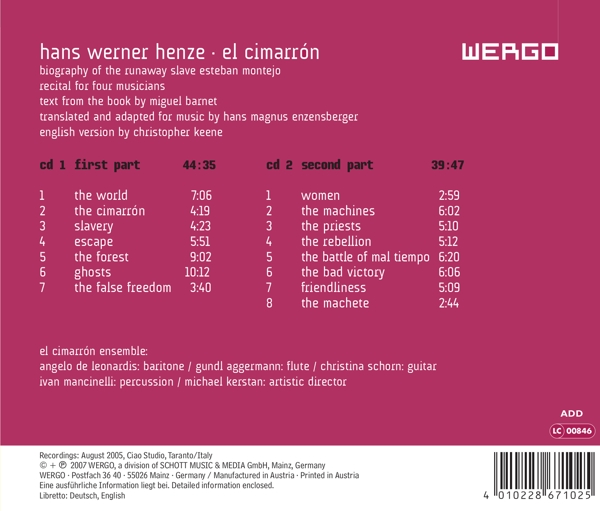
Disc 01 El Cimarr˘n (Rezital für vier Musiker) 01. "Die Welt (The world) (1. Teil)" 02. "Der Cimarr˘n (The Cimarr˘n)" 03. "Die Sklaverei (Slavery)" 04. "Die Flucht (Escape)" 05. "Der Wald (The forest)" 06. "Die Geister (Ghosts)" 07. "Die falsche Freiheit (The false freedom)"
Disc 02 01. "Die Frauen (Woman) (2. Teil)" 02. "Die Maschinen (The machines)" 03. "Die Pfarrer (The priests)" 04. "Der Aufstand (The rebellion)" 05. "Die Schlacht von Mal Tiempo (The battle of Mal Tiempo)" 06. "Der schlechte Sieg (The bad victory)" 07. "Die Freundlichkeit (Friendliness)" 08. "Das Messer (The machete)"
|
 |
| Number of discs: |
2 |
 |
| Description: | "El Cimarrón" is one of the most important examples of politically engaged music - a milestone in the history of Hans Werner Henze's oeuvre, musical theater that had not been known or mastered previously. In his "recital for four musicians", Henze tells the story of Esteban Montejo, an escaped Cuban slave who, at the age of 104, was interviewed extensively about his life by the Cuban ethnologist and writer Miguel Barnet. Barnet's book provided the model for a libretto by the German writer Hans Magnus Enzensberger which was translated into English by Christopher Keene. In Henze's composition, there is a narrative gesture that derives from Esteban Montejo's speaking style, which was captured on tape. And there is the basso continuo, the musical foundation from which the whole thing grows and produces it's new blossoms. It was derived from and developed on ancient African (Congolese-Cuban) percussion music. That is the often quite but often loud pulse of our Cimarrón. |
 |
| No. of tracks: |
15 |
 |
| Manufacturer No.: |
WER67102 |
 |
Product Safety
Responsible Person for the EU:
Schott Music GmbH & Co. KG Weihergarten 5, 55116 Mainz, DE service@wergo.de |
 |