Die Klavierwerke vol.10

Thomas Schultz
Die Klavierwerke vol.10Audio

11,89 EUR  9,29 EUR
plus shipping and customs
Offer ends in 6 days
CD
Mode Records
Shipping charges are minimized.
Die Klavierwerke vol.10 114 visitors
are looking at this item
Delivery to US in: 3-7 workdays (only 1 left in stock)
Sales Rank: #731 in Piano
#20939 in Classic
Style: Piano
Product No.: 2098273475

Accessories

Content:

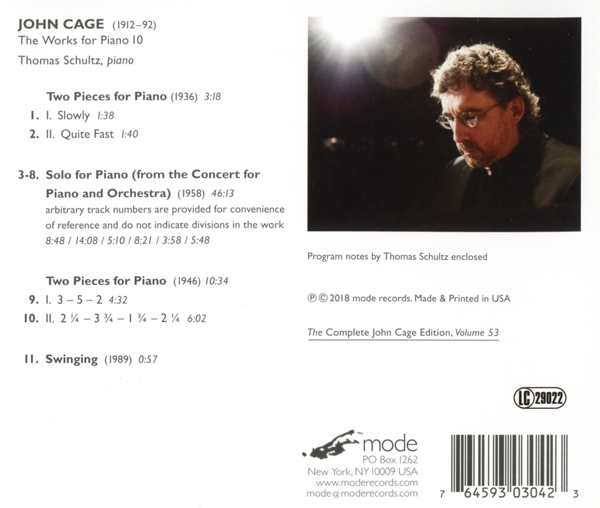
Details / Tracklist: Stücke für Klavier Nr. 1-2 (1936)
MP3 Audio listen now for free 01. "Nr. 1 Slowly"
MP3 Audio listen now for free 02. "Nr. 2 Quite fast"
Konzert für Klavier und Orchester (1957/58) (Auszug)
MP3 Audio listen now for free 03. "1. Ohne Satzbezeichnung"
MP3 Audio listen now for free 04. "2. Ohne Satzbezeichnung"
MP3 Audio listen now for free 05. "3. Ohne Satzbezeichnung"
MP3 Audio listen now for free 06. "4. Ohne Satzbezeichnung"
MP3 Audio listen now for free 07. "5. Ohne Satzbezeichnung"
MP3 Audio listen now for free 08. "6. Ohne Satzbezeichnung"
Stücke für Klavier Nr. 1-2 (1946)
MP3 Audio listen now for free 09. "Nr. 1 3 - 5 - 2"
MP3 Audio listen now for free 10. "Nr. 2 2 1/4 - 3 3/4 - 1 3/4 - 2 1/4"
MP3 Audio listen now for free 11. "Swinging (1989)"
Number of discs: 1
Extra-Infos: Thomas Schultz
Description:John Cage: The Works For Piano 10 by The Arditti Quartet, released 20 July 2018. This version of John Cage: The Works For Piano 10 comes as a 1xCD. - THOMAS SCHULTZ
The Solo for Piano is part of the legendary "Concert for Piano and Orchestra." It is an indeterminate work, consisting of 63 pages made of 84 different types of composition, each appearing as it's own type of notation. The performer creates his own performance by choosing which pages to play and in which order; pages can also be omitted. Cage began by choosing, using chance operations, a way of composing based on either his Music for Piano series - single notes, or on Winter Music - chords, or aggregates of notes. Chance operations would also determine whether a variation on one of these two types would be used or whether something completely new, with it's own subsequent variations, would be written. When Cage wrote the Two Pieces for Piano (1935), he was already studying with Arnold Schoenberg. Schoenberg's influence on Cage undoubtedly accounts for the music's 12-tone-row-based organization, but Cage's own version of this system had the twelve note series broken down into short pitch/rhythm cells. Later Cage began a study of Indian philosophy and came to believe that the purpose of music is "to imitate nature in it's manner of operation" and "to sober and quiet the mind thus rendering it susceptible to divine influences." These principles underlie another set of piano pieces that Cage wrote in the months May to August, 1946, entitled again, Two Pieces for Piano (1946). These later pieces are more extensively worked out and possess a sense of urgency and heightened drama, brought about in the first piece by long silences and in the second by a quicker flow and variety of musical events distributed over a greater range of the instrument. The silences heard in the first piece are an early example of what later became a pillar of Cage's thought and music - the primacy of silence.
Manufacturer No.: MODE304
Product Safety

Other products from Mode Records

display all

Product feedback

Write a feedback
There are currently no product reviews.