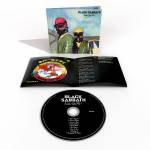
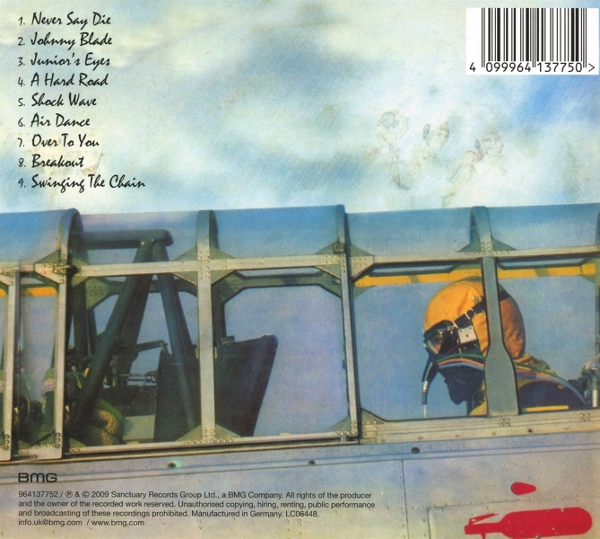
Yuriy P. - 14/Feb/2026  There's a strange rule that dictates how a band can exist without conflict for about ten years. At this crucial point, breakups, key members leave, weak albums are released, stylistic quirks, and the like occur. It's not that this scenario is 100% guaranteed, but it's a very common one, and commercial success and creative integrity have nothing to do with it. Critically acclaimed millionaire stars end up doing the same thing as underground bands with a single demo that gets two stars out of ten in a fanzine.
By 1977, Sabbath's musicians were only about thirty years old, rich, famous, and thousands of their unfortunate colleagues would have signed contracts in blood to be in their shoes. But fame and big money, which had suddenly descended on the immature psyches of these provincial boys a few years earlier, sent Sabbath spiraling into a drug-fueled tailspin, falling out with each other, and collapsing into a creative crisis. The latter was compounded by the fact that Iommi, Butler, Osbourne, and Ward had churned out so much brilliant music over five years that their inspiration had simply dried up. A break from the album-and-tour schedule and a more moderate lifestyle might have helped, but no.
Perpetually drunk and mutually hating, the four original members, assisted by keyboardist Don Airey, spent five months laboring to produce the album that effectively ended the band and became their last collaboration for two decades.
After all this, one might conclude that "Never Say Die!" It's a kind of "spit into eternity," but in reality, it's more unfocused and absurd than odiously bad.
Sabbath abandoned the "dark" concept and, accordingly, their proto-doom sound. This is the band's most lightweight and upbeat album. They attempted to conceal the apparent paucity of ideas by overcomplicating the form—hence the synthetic keyboards, brass arrangements, vocal polyphony, and other techniques from the arsenal of progressive bands of the same era. In some moments, "Never Say Die!" is remarkably reminiscent of contemporary Uriah Heep albums, similarly light, synthesizer-driven, and lost, a kind of "symphonic-pop-folk-hard-art-rock about nothing."
So it turns out that the band that recorded "Never Say Die!", despite having an identical lineup, has little in common with the band that recorded "Paranoid." Sabbath's key figures, Iommi and Butler, are somehow inaudible and unnoticeable on the album. They haven't forgotten how to play, but they play completely differently, not like the people who brought "Children of the Grave" or "Sabbath Bloody Sabbath" to the world. Meanwhile, Osbourne, who's almost off to pursue a solo career, thanks to his unique vocal style, never forgets the name of the band you're listening to.
If the album had actually been released with a different singer, as planned, it could have killed Sabbath so badly that no "Man from Silver Mountain" could have resurrected it.
The album's first song is more or less a hit, a fast-paced actioner, but like all of Sabbath's attempts (except "Paranoid"!) to rev up the throttle and crank up the speed, the result is clumsy. Ozzy also reaches the heights of his distinctive voice, sounding like a cartoon villain.
"Johnny Blade," though about a criminal, is doused with keyboards like a cake in syrup, and "Junior's Eyes" is a beautiful and melodic, and absolutely un-Sabbath-esque song. The autobiographical "Hard Road" is a middling rhythmic hard rocker with otherworldly, talentless choral backing vocals, during the recording of which Butler laughed at Iommi's attempts at singing.
The album then plods along, and the jazzy "Breakout" (naturally jazzy, with a horn section!) manages to awaken a dozing listener, but you wake up more with the thought, "What happened?!" than with "What wonderful music is this?" Legend has it that the song was chosen as an instrumental because Ozzy refused to sing with such accompaniment. The crowning glory is "Swinging the Chain," sung by Bill Ward, about which nothing bad (or good) can be said, except that it belongs on Ward's solo album.
|