Bisherige Auswahl:
keine Auswahl
Ergebnis einschränken:
|
 |
| Bemerkungen / Titelliste: |
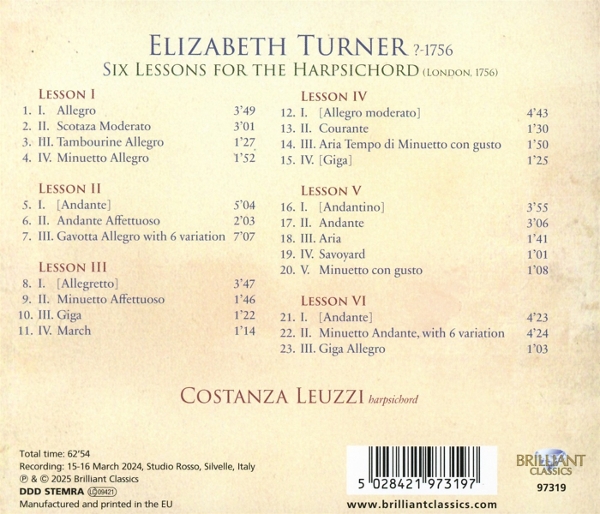
Etüde für Cembalo Nr. 1 01. "1. Allegro" 02. "2. Scotaza: Moderato" 03. "3. Tambourin: Allegro" 04. "4. Menuett: Allegro" 01. "1. Allegro" 02. "2. Scotaza: Moderato" 03. "3. Tambourin: Allegro" 04. "4. Menuett: Allegro"
Etüde für Cembalo Nr. 2 05. "1. Andante" 06. "2. Andante affettuoso" 07. "3. Gavotte: Allegro mit 6 Variationen"
Etüde für Cembalo Nr. 3 08. "1. Allegretto" 09. "2. Menuett: Affettuoso" 10. "3. Giga" 11. "4. Marsch"
Etüde für Cembalo Nr. 4 12. "1. Allegro moderato" 13. "2. Courante" 14. "3. Aria: Tempo di minuetto con gusto" 15. "4. Giga"
Etüde für Cembalo Nr. 5 16. "1. Andantino" 17. "2. Andante" 18. "3. Aria" 19. "4. Savoyard" 20. "5. Menuett: Con gusto"
Etüde für Cembalo Nr. 6 21. "1. Andante" 22. "2. Menuett: Andante mit 6 Variationen" 23. "3. Giga: Allegro"
|
| | Anzahl der Tonträger: |
1 |
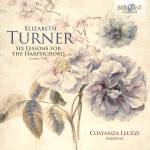
| | Beschreibung: | On the English musical landscape of the second half of the 18th century, the name Elizabeth Turner stands out as a rare example of a female musician flourishing on British soil. She was successful singer on London's stages between about 1740 and 1756, as well as a composer and harpsichordist. Few of her biographical details have come down to us: her date of birth is unknown, and her year of death (1756) is inferred from reports in English newspapers of the time. The number and dates of printed references to her singing (the earliest is from March 1744) suggests a premature passing that interrupted an acclaimed vocal career. Rivalled only by her fellow singer-composer and contemporary Elisabetta de Gambarini (1731-1765, a Londoner of Italian descent), Elizabeth Turner alternated her activity on the stage with composition, publishing two volumes. The first, Twelve Songs, With Symphonies and a Thorough Bass for the Harpsichord (London, 1750), is a collection of English folk songs; the second, A Collection of Songs With Symphonies and a Thorough Bass. With Six Lessons for the Harpsichord (London, 1756), places 19 songs on texts by British poets alongside 6 lessons for harpsichord. The 'Lessons' genre was one very much in vogue in mid-18th-century England, as evidenced by Purcell's A Choice Collection of Lessons for the Harpsichord or Spinnet (1696), the aforementioned Gambarini's Six Sets of Lessons for the Harpsichord (1748), and Thomas Arne's VIII Sonatas or Lessons for the Harpsichord (1756). Turner's Six Harpsichord Lessons here receive their first complete recording. Each is divided into several movements, in the manner of a sonata. The style is often similar to that of the companion songs in her volume, whose melodies refer distinctly to the models of the tradition (from Purcell down to Boyce, via Thomas Arne and Maurice Greene). This is music intended for refined and cultured amateur performers, whose performances were moments of social conviviality where playing constituted pure pleasure. Yet in a society, such as England's, that relegated the role of women in music to the horizon of amusement, entertainment and domestic pastime, the figure of Elizabeth Turner emerges with disruptive and revolutionary force. Her sort of revolution is not one that demands a paradigm shift, it does not aspire to break the mould, it does not have a vocation for destruction: it is a gentle revolution, made up of elegance and grace, and precisely in it's gentleness it calls out to be heard, an invitation we cannot decline. Other information:- Recorded March 2024 in Silvelle (Italy)- Booklet in English contains liner notes by Maddalena Bonechi, as well as a note from the performer and her biography- Costanza Leuzzi plays a French double-manual harpsichord (anon. , after Pascal Taskin; renovated 2020, Andrea Di Maio) tuned to the Young II temperament at a=415- Italian liner notes available at brilliantclassics. Com- Elizabeth Turner's (?-1756) Six Lessons for Harpsichord, published in 1756, the year of her death, is a significant contribution to 18th-century keyboard music, reflecting the stylistic characteristics of the time. Little is known about Turner herself, but her work stands as one of the few harpsichord collections by a female composer during that era, making it a valuable historical artifact. The Six Lessons are structured as suites, each consisting of multiple short movements, such as minuets, and gigues, which were popular dance forms in Baroque music. - Turner's compositions exhibit a blend of French and Italian influences, which were prevalent in English harpsichord music of the period. The pieces are characterized by their elegant melodic lines and ornamentation, typical of the French style, alongside rhythmic vitality that hints at Italian practices. The works are accessible for amateur performers, suggesting they were intended for domestic music-making rather than professional concert settings. - The Six Lessons offer insight into the musical tastes and domestic entertainment practices of 18th-century England, particularly for women, who were often encouraged to learn keyboard instruments. Turner's work is a rare example of a published female composer in a male-dominated field. - Costanza Leuzzi, a pupil of Roberto Loreggian, wrote a dissertation on the life and work of Elizabeth Turner. With the purpose of giving new life to Turner's music, Costanza also founded an ensemble of young musicians and gives concerts where she combines the musical performance and the storytelling of the English composer's life. - The interest in unknown authors and forgotten musical literature is the main focus of Costanza's musical career, which aims to share lost masterpieces that deserve to be rediscovered in our time., Labelcode BRLT97319.2"Turner: 6 Lessons For The Harpsichord (1756)" ist eine faszinierende CD-Veröffentlichung von Brilliant Classics und präsentiert die feinsinnige Kunst von Turner sowie des Cembalisten Francesco Leuzzi. Das Album bringt sechs erlesene Lektionen aus dem Jahr 1756 zum Klingen und entführt den Hörer auf eine authentische Reise durch die Welt der barocken Tastenmusik. Jede Lektion zeugt von Turners Meisterschaft im melodischen Einfallsreichtum und kunstvoller Verzierungskunst ? sensibel und historisch informiert interpretiert von Leuzzi. Die Aufnahme belebt nicht nur ein kaum bekanntes Juwel des Cembalo-Repertoires neu, sondern gewährt auch Einblicke in die Musikpädagogik des 18. Jahrhunderts.
Francesco Leuzzi gilt als Experte für historische Aufführungspraxis mit besonderem Schwerpunkt auf Tasteninstrumenten wie dem Cembalo. Seine Interpretationen werden für ihre Klarheit, Ausdrucksstärke und wissenschaftliche Fundiertheit geschätzt.
Brilliant Classics genießt weltweit einen exzellenten Ruf für hochwertige Klassikproduktionen zu erschwinglichen Preisen. Mit einem umfangreichen Katalog vom Barock bis zur Moderne hat sich das Label bei Sammlern wie Neueinsteigern gleichermaßen beliebt gemacht ? dank hochwertiger Aufnahmen und dem Anspruch, großartige Musik zugänglich zu machen. | | | Herstellernummer: |
2997319BRC |
| Details zur Produktsicherheit
Verantwortliche Person für die EU:
Brilliant Classics B.V.
Glienholzweg 7, 17207 Röbel, DE
info@brilliantclassics.com | |
|
Zu diesem Artikel liegen leider noch keine Bewertungen vor.
|  |
|
|
|
|
|
|
|
|
|
| |
- Du besitzst "Turner:6 Lessons For The Harpsichord (1756)" oder kennst den Artikel bereits?
- Dann schreibe doch eine Produktbewertung.
- Wir belohnen deine Mühen mit Bewertungspunkten, einlösbar für exklusive Gratisartikel.
|
|
|
|
|
|
|
|
|





 Soloinstrument
5.924
Soloinstrument
5.924